
HODL or Rebalance? Why Your Crypto Strategy Needs a 'Flight Simulator'
We’ve all been there: staring at a portfolio, wondering if we should just "set it and forget it" (HODL) or if we need to actively move money around to stay safe. In the world of DeFi (Decentralized Finance), where rewards (APR) can be high but prices move fast, guessing is a dangerous game.
At Qalc.ai, we believe you shouldn't have to guess. We built a "flight simulator" for your money—the Flywheel Effect Simulator. Today, we’re going to use it to settle a 10-year debate: Is it better to be a passive holder or an active balancer? We ran two 10-year simulations with a starting $50,000, and the results might surprise you.
The Starting Line: $50,000 and a Dream
For both tests, we used the exact same setup. We pretended we have $50,000 to invest across three common "buckets":
- The "Growers" (Held Assets): Standard coins you think will go up in value (8% growth per year).
- The "Workers" (Liquidity Pools): Assets that earn you fees (25% APR) but are a bit more volatile.
- The "Safety Net" (Lending/Stables): Conservative assets earning a steady 8% APR.
We set the clock for 10 years. Why 10 years? Because that’s where the "Magic of Compounding" (earning interest on your interest) really shows its teeth.
Scenario 1: The "Lazy" Strategy (Hold Independent)
In this first scenario, we did absolutely nothing. We put the money in the buckets and walked away for a decade.
The Strategy:
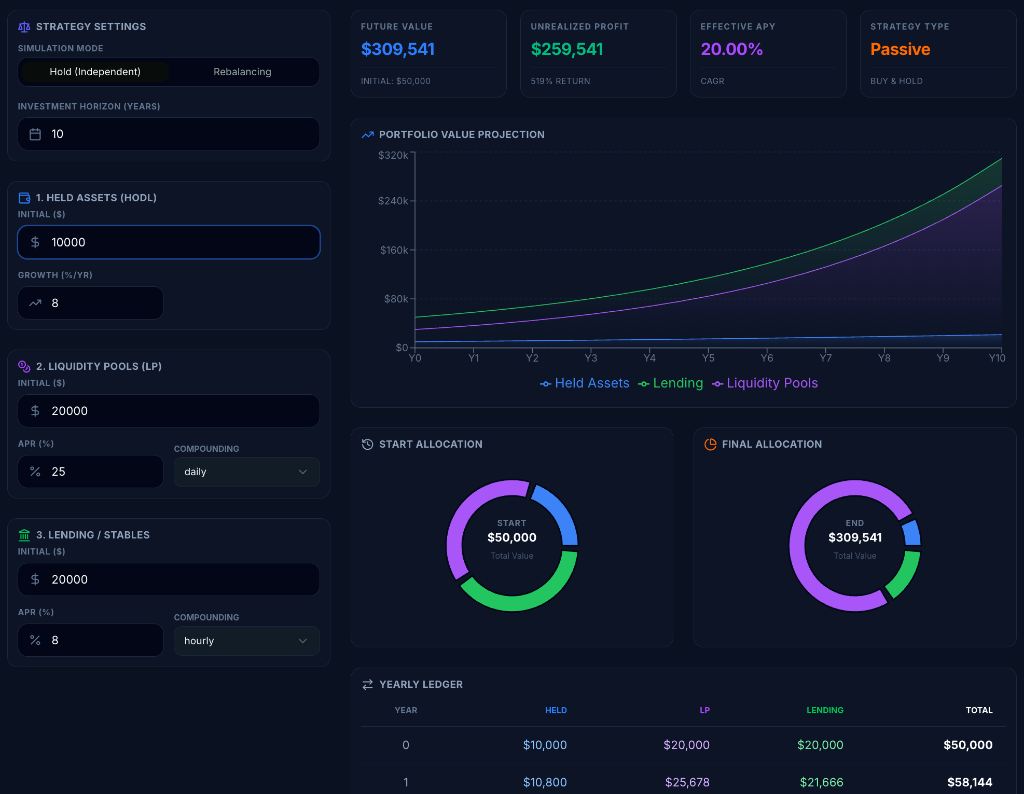
- Held Assets: $10,000.
- Liquidity Pools (LPs): $20,000 (Daily compounding).
- Lending: $20,000 (Hourly compounding).
- Active Management: Zero. No moving money between buckets.
The Results: After 10 years, the total jumped to $309,541. That is a $259,541 profit!
The "Catch" (The Danger Zone): Look closely at the "FINAL ALLOCATION" chart in the first image. Because the "Workers" (LPs) grew so much faster than everything else, they now make up the giant purple chunk of the pie.
The Problem: You started balanced, but you ended up "heavy" in one area. If that specific asset crashes in year 11, your whole $300k is at high risk because you let one bucket grow too big. This is what we call "unmanaged risk."
Scenario 2: The "Smart Manager" (Active Rebalancing)
In the second test, we told our simulator: "Every month, check my buckets. If one gets too big, sell some profit and put it back into the safety net." We wanted to keep a perfect 50/50 split between our "Workers" and our "Safety Net."
The Strategy:
- Liquidity Pools (LPs): $25,000 (Target: 50% of portfolio).
- Lending: $25,000 (Target: 50% of portfolio).
- Check Frequency: Monthly. If one side grows 1% more than the other, we balance them back.
The Results: After 10 years, the total reached $258,951.
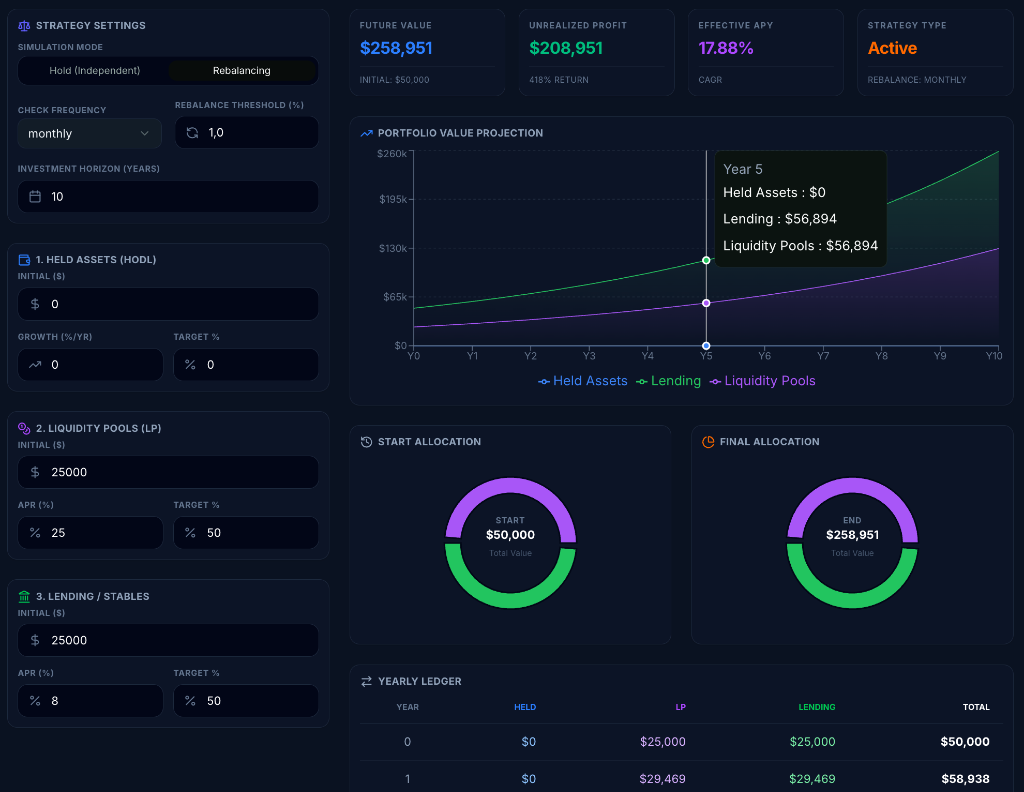
Wait, why is it lower? You’ll notice this is about $50k less than the "Lazy" strategy. Here’s why: because you were constantly selling your "winners" (the LPs) to buy more "safety" (Lending), you didn't let the high-interest engine run at full speed.
The "Win" (Peace of Mind): Look at the tooltip for Year 5 in the second image. The buckets are perfectly equal: $56,894 each.
The Benefit: If the market crashes tomorrow, you have a massive pile of stable "Safety Net" assets to protect you. You traded a bit of potential profit for a lot of security. You are the boss of your risk, not the market.
Which One is Right for You?
There is no "perfect" answer, only the answer that lets you sleep at night.
- The HODL Path is for people who believe their assets will only go up and don't mind if their portfolio becomes "unbalanced" over time. It can lead to higher peaks, but also much deeper valleys.
- The Rebalancing Path is for the "Pro" who wants a steady, predictable machine. It's about taking wins off the table regularly so you never lose it all in one go.
Try the "Flight Simulator" Yourself
Don't take our word for it—run your own numbers. Maybe your LP earns 50% APR? Maybe you only want to rebalance once a year?
Our tool at Qalc.ai lets you play with these numbers in seconds. It’s visual, it’s fast, and most importantly: it’s private.
- No tracking: We don't want your email.
- No wallets: We don't want your keys.
- Pure Math: All calculations happen right in your browser.
🔗 Test your strategy here: qalc.ai/defi/flywheel-effect
(Pro tip: Type "flywheel" into the search box on our homepage to jump straight in!)
We want to hear from you!
Are you a "set it and forget it" investor, or do you like to keep things balanced? Post your simulation results here in r/qalc_ai! If you have a specific idea for a new calculator (like a loan payoff or a different DeFi protocol), let us know—we build what the community asks for.
Let's stop guessing and start calculating.